
Disclosure up front: I work on one of the three. I've tried to make that irrelevant by quoting the other two rather than characterising them, and by including a section on where each of us loses. All quotes are from public documentation, checked 27 September 2026.
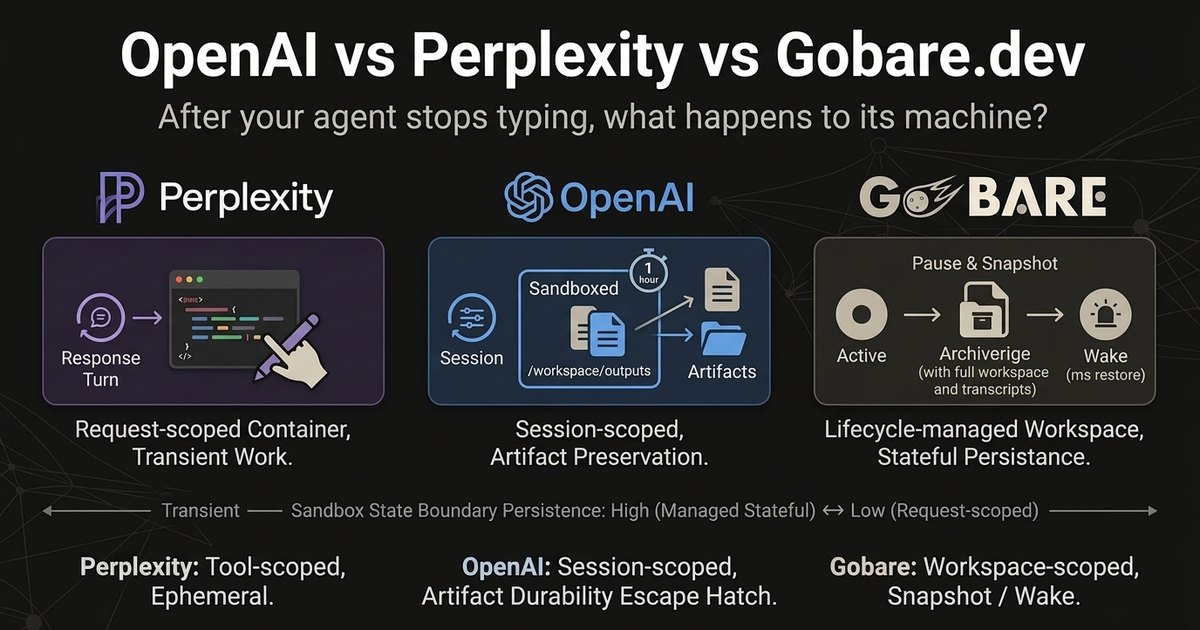
Three agent runtimes. One question: when your agent stops typing, what happens to its machine?
Perplexity, on their sandbox tool:
"Multiple executions in a single response share the same container: files written and packages installed by an earlier step are still there for a later one."
OpenAI, on hosted sandboxes:
"If activity and keep-alives stop for an hour, the sandbox can be deleted."
…and separately, that files written to /workspace/outputs become immutable
artifacts on turn completion, and those copies "remain downloadable after the
sandbox expires."
Gobare, on limits:
"A workspace is also paused after five minutes with nothing happening, and woken by the next thing you send."
Three different answers. None of them wrong — they're building different things. But if you pick one without noticing, you find out at the worst possible moment: an hour into a job, at the exact step where the work was supposed to land.
First, a distinction almost every comparison gets wrong
OpenAI ships two things with confusingly similar names, and they are not layers of each other. They are mutually exclusive answers to one question: who runs the agent loop?
The Agents SDK is open source and runs in your process. You own the loop. It is genuinely provider-flexible — Claude and Gemini work through LiteLLM in Python, or the AI SDK adapter in TypeScript.
The Agents API is hosted. OpenAI runs the loop, and the managed sandbox, artifacts, and Responses path are built around it. OpenAI's own guidance leans toward their models here and warns that certain features depend on the Responses path rather than compatibility surfaces.
So "can I use Claude with OpenAI's agent stuff?" has two answers depending on which product you meant. In the SDK, yes, on a well-trodden path. In the hosted Agents API — the one with the sandbox — you're on a second-class path, and features that depend on the Responses path may not carry over.
Everything below is strictly about hosted runtimes: the ones that give you a machine.
Three answers to one question
Each of these is a coherent answer to a different product question.
Perplexity's is the tightest. Their sandbox is a tool — you enable it, the model writes and runs its own code, and you get the code back in the response so you can inspect it. Multiple executions within one response share a container, so intermediate files work. Between responses, nothing is promised. That is exactly right for what they're building: an answer engine that can compute. If what you want is an answer, paying to keep a machine alive afterwards is pure waste.
OpenAI's hosted sandbox is session-scoped, with keep-alives between turns,
and an explicit durability escape hatch: write to /workspace/outputs and it
becomes an immutable artifact that outlives the sandbox. That's a clean
contract. It also tells you exactly what the sandbox is for — a place to do
work, not a place to keep it.
Their self-hosted option
is the interesting one, and underdiscussed. You can point the runtime at your
own compute; Daytona
is documented as a provider. Their own guide flags the trap: the executor's
connection to OpenAI is outbound and long-lived, and the provider's inactivity
tracking doesn't see it, so you must set auto_stop_interval=0 or your sandbox
stops mid-agent.
Gobare — the one I work on — pauses the sandbox when a session idles and, before the machine is reclaimed, snapshots the workspace files back to the control plane and restores them on wake. The transcript lives in the control plane regardless. It is best-effort, not total: git history, installed dependencies and running processes are not in the snapshot, and a workspace over 300MB is skipped. Different bet: that the working directory should outlive the machine, not only the files you remembered to export.
When the difference actually bites
Three concrete cases where the architectural answer changes what you can build:
- A job longer than the idle window. A refactor that runs 40 minutes across several turns, with gaps while your dispatcher does something else. On a per-request container this isn't expressible — each response starts clean. On a session sandbox it works, as long as you understand what "idle" means to your provider. Read that definition carefully; on self-hosted compute, it is your definition and it will not match the runtime's.
- A task that has to stop and ask. Human approval mid-run means the machine waits, possibly for hours. Whether that wait is free, expensive, or impossible depends entirely on how the runtime treats an idle machine — the three answers above.
- An agent that serves something. If the agent starts a local web server and you want it reachable (a live UI preview, say), the machine has to exist when the visitor arrives — which might be long after the agent stopped generating code. If the sandbox vanishes when execution finishes, your preview URL dies with it.
None of these are hypothetical failure modes of a bad runtime. They are the places where a correct runtime, chosen for the wrong shape of work, produces a system you cannot finish.
The price of a machine is already public
Perplexity publishes something the others don't: a price for the container itself. From their pricing page:
"$0.03 per session (≤20-min billing window)"
and from the sandbox docs, a session "covers up to 20 minutes of active use for billing purposes." That's roughly $0.09 an hour for a managed container, and it's the clearest public anchor available for what hosted agent compute costs.
The rest of their pricing explains the shape of the product. Third-party model
tokens pass through at published provider rates. Tools are metered: web_search
at $0.0025 a call, fetch_url at $0.0005. The money is in the search index —
which is the asset they have and nobody else does. The Agent API is how you
reach it.
Worth naming plainly, because it sets the floor for everyone else: for one of the three, the runtime does not need to be profitable.
Where each of these loses
The part that makes the rest of this worth reading.
- Perplexity has no session state. If your work needs to survive a response
boundary, you build that state machine yourself on top of
previous_response_id, and the underlying machine is not part of what survives. - OpenAI hosted deletes the sandbox after an hour of quiet and preserves only
what you explicitly published to
/workspace/outputs. If your valuable state is a half-finished working tree rather than a file you remembered to export, it's gone. And on the hosted path, non-OpenAI models remain second-class citizens. - OpenAI self-hosted hands you the lifecycle, which means it also hands you the outages and edge-case management. Their Daytona guide is an admirably honest read about how many ways idle-stop can go wrong.
- Gobare is single-provider: strictly E2B, with no bring-your-own-compute. That's real lock-in and the most legitimate criticism of us on this page. A workspace is also reclaimed two hours of active time after it starts; paused time doesn't count, but a turn still running then ends as failed, so work that genuinely needs longer has to be split across sessions. We have no model fallback chain — Perplexity lets you pass up to five models and tries them in order, which is a straightforwardly better answer to provider outages than anything we have today. Their configuration profiles are versioned; our saved agents are not. And we have no search index and no intention of building one.
The question to ask
Not "which runtime is best." Ask:
After my agent stops typing, do I still need the machine?
If no — you want an answer, not a workspace — a per-request container is the right shape and you shouldn't pay for more. Perplexity's model is the honest version of that.
If yes, you're choosing between owning the compute yourself and finding someone who will manage its state for you. Both are defensible choices. What's not defensible is not knowing which one you picked — which is easy to do, because every one of these products will happily run your first 30-second demo.
The docs answer it. They're just three different answers, and none of them are on the page you'd think to look at.
Sources, checked 27 September 2026: Gobare Sessions · Design decisions · Limits. OpenAI OpenAI-hosted sandboxes · Self-hosted sandboxes · Daytona provider · Models and providers · Architecture. Perplexity Sandbox tool · Tools overview · Pricing · Create Agent Response.