
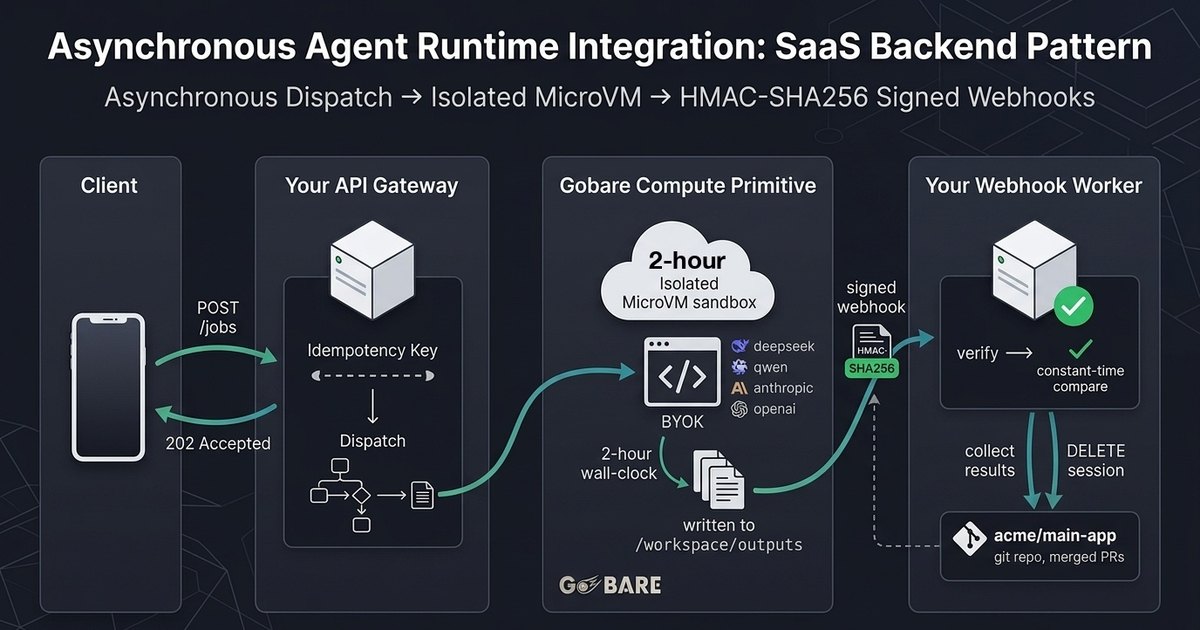
You want a feature where a user asks for something and a coding agent goes and does it: clones a repo, runs the tests, writes a report. The work takes minutes. You don't want a request thread waiting that long, and you don't want to poll.
The shape that works is one POST out and one webhook back. Your API returns 202 straight away, the agent works on its own machine, and a signed webhook tells your backend when there is something to collect. This post is the Gobare quickstart rebuilt that way. The three snippets below are condensed from one runnable file, linked at the end.
client ── POST /jobs ──▶ your API ── POST /v1/sessions ──▶ Gobare: agent on its own machine
       ◀── 202 job_id ──          (holds nothing open)
                          your API ◀── signed webhook ──── turn.completed
                          GET turn, reply, files; DELETE session
client ── GET /jobs/:id ▶ answer and files
Once per organization
Connect a model key (it is verified on save and never enters a sandbox), then subscribe your webhook endpoint:
curl -s -X POST https://api.gobare.dev/v1/model-credentials \
  -H "Authorization: Bearer $GOBARE_TOKEN" -H 'content-type: application/json' \
  -d '{"key":"sk-ant-api03-…"}'

curl -s -X POST https://api.gobare.dev/v1/webhooks \
  -H "Authorization: Bearer $GOBARE_TOKEN" -H 'content-type: application/json' \
  -d '{"url":"https://your-backend.example/hooks/gobare",
       "events":["turn.completed","turn.failed","session.action_required"]}'
The webhook response carries a secret. It is shown once; store it. For keys that start with a bare sk-, add "provider" (for example "deepseek") so the key is only sent to the vendor you named.
1. Start the job and return
app.post("/jobs", express.json(), async (req, res) => {
  const jobId = randomUUID();
  const { task, repo } = req.body;

  let session;
  try {
    session = await gobare("POST", "/sessions", {
      agent: { model: MODEL },
      ...(repo ? { environment: { repo } } : {}),   // "owner/name"
      metadata: { job_id: jobId },                  // comes back on every read of the session
      input: `${task}\n\nWrite anything you produce as files under /workspace/outputs.`,
    }, { "idempotency-key": `job-${jobId}` });      // a retried dispatch can't start a second agent
  } catch (err) {
    return res.status(502).json({ error: "could not start the agent" });
  }

  jobs.set(jobId, { sessionId: session.id, status: "running" });
  res.status(202).json({ job_id: jobId, status: "running" });
});
gobare() is a ten-line fetch wrapper that adds the bearer token. The session is created immediately and its machine comes up behind it, so you never wait for it before sending work.
2. Receive the webhook
function verify(timestamp: string, body: string, signature: string) {
  const expected = createHmac("sha256", SECRET).update(`${timestamp}.${body}`).digest("hex");
  if (expected.length !== signature.length) return false;
  if (!timingSafeEqual(Buffer.from(expected, "hex"), Buffer.from(signature, "hex"))) return false;
  return Math.abs(Date.now() - Number(timestamp)) <= 5 * 60_000;  // milliseconds
}

// express.raw, not express.json: the signature is over the exact bytes sent.
app.post("/hooks/gobare", express.raw({ type: "application/json" }), (req, res) => {
  const body = req.body.toString("utf8");
  if (!verify(req.header("x-gobare-timestamp") ?? "", body, req.header("x-gobare-signature") ?? ""))
    return res.sendStatus(400);
  res.sendStatus(200);                     // answer within 10 s, then do the work
  handle(JSON.parse(body)).catch(console.error);
});
The payload is small on purpose. It names the session and, for turn events, the turn: {"type":"turn.completed","data":{"session_id":"…","turn_id":"…"}}. Deliveries are at least once and can arrive out of order, so handle skips a type:turn_id pair it has already seen, then reads the session for current state and routes on the event type.
3. Collect the result and free the machine
async function collect(jobId: string, sessionId: string, turnId: string) {
  const turn = await gobare("GET", `/sessions/${sessionId}/turns/${turnId}`);
  if (turn.artifacts === "pending") return setTimeout(() => collect(jobId, sessionId, turnId), 5_000);

  const { data: items } = await gobare("GET", `/sessions/${sessionId}/items?limit=20`);
  const reply = items.find((i: any) => i.type === "message" && i.role === "assistant");

  const { data: artifacts } = await gobare("GET", `/sessions/${sessionId}/artifacts?turn_id=${turnId}`);
  await mkdir(`out/${jobId}`, { recursive: true });
  for (const a of artifacts) {
    const file = await fetch(`${API}/sessions/${sessionId}/artifacts/${a.id}/content`,
      { headers: { authorization: `Bearer ${TOKEN}` } });
    await writeFile(`out/${jobId}/${a.path.split("/").pop()}`, Buffer.from(await file.arrayBuffer()));
  }

  jobs.set(jobId, { sessionId, status: "completed", answer: reply?.content ?? "", files: artifacts.map((a: any) => a.path) });
  await gobare("DELETE", `/sessions/${sessionId}`);   // a session holds a concurrency slot until deleted
}
Two answers come back, and you usually want both. The prose is the newest assistant message in items. The files are artifacts: anything the agent wrote under /workspace/outputs, which outlives the session. turn.failed goes the same way: read turn.error, record it, delete the session.
When the agent needs your code
Declare a function in agent.tools when you create the session, and the agent can call it. The session then stops with session.action_required, your handler runs the function and answers with an input.tool_result carrying the turn_id and call_id from the request. Send a fixed error string when your function fails, never a stack trace, because it goes to the model. Approvals and questions are for a person: answer them later with input.approval or input.question_answer, or in the Console. The full file does all of this.
The full example
server.ts, package.json and a README → About 190 lines: dispatch, verification, dedupe, collection, function calls and failure handling.
npm install
export GOBARE_TOKEN=gbr_pat_... GOBARE_WEBHOOK_SECRET=whsec_... GOBARE_MODEL=MiniMax-M3
npm start
cloudflared tunnel --url http://localhost:3000   # a public HTTPS address for the webhook
Seven things that fail quietly
| Symptom | Cause | Fix |
|---|---|---|
| Every delivery fails verification | You verified parsed-then-reserialised JSON | Verify the raw body |
| Still failing, and the secret is right | You divided the timestamp by 1000 | x-gobare-timestamp is milliseconds |
| A job finishes twice | Deliveries are at least once | Dedupe on type + turn_id |
| A completed turn has no files | Publishing hadn't finished | Wait until turn.artifacts isn't pending |
| Your function is never called | It was handled but not declared | Declare it in agent.tools at creation |
New sessions refused with project_limit_exceeded |
Old sessions were never deleted | Delete on completion; 25 concurrent per organization by default |
| A long job stops near two hours | A sandbox is reclaimed two hours after it was created, paused time included | Split long work into turns; the next input starts a fresh sandbox from a snapshot |
The first turn on a cold machine can take minutes rather than seconds. That is the reason for the webhook, not a failure.
Before production
- Split the token. The dispatcher needs
sessions:write. The webhook worker needssessions:read,tools:respondandartifacts:read. A token with onlytools:respondcan answer function calls but can't message, cancel or delete a session. - Persist the dedupe keys and jobs in your database, with a unique constraint on the key.
- Pace session creation.
POST /v1/sessionsallows 10 per minute per token. Every response carriesx-ratelimit-remaining.
More in the docs: quickstart · webhooks · required actions · limits · OpenAPI spec.