
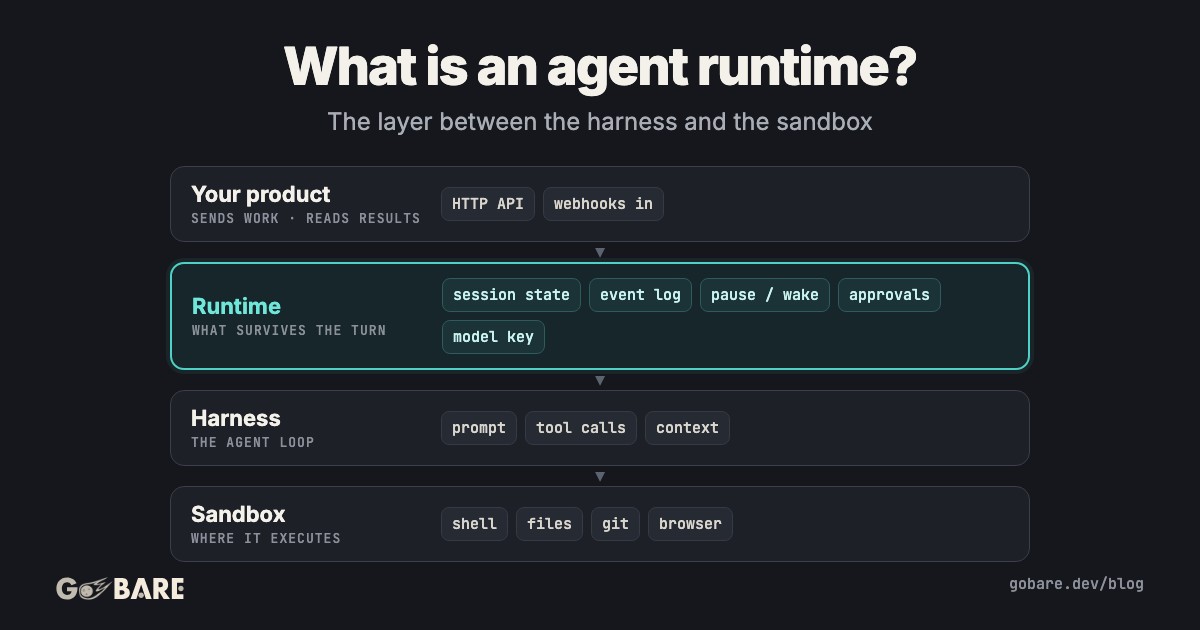
An agent runtime is the layer that runs an agent's work over time. It keeps the session's state and its history of events, decides when the machine sleeps and wakes, pauses the work when a person or your code has to answer, and holds the credentials the agent must never read. The harness decides what the agent does. The sandbox is where it does it. The runtime is why it is still there tomorrow.
That is the short answer. The long one is worth having, because the four words people use for this stack — framework, harness, runtime, sandbox — are used differently by almost everyone who writes about them. LangChain, which coined much of the vocabulary, says in its own post that there is no clear definition of framework versus runtime versus harness.
Disclosure: we build Gobare, which is a hosted agent runtime. We run the three layers as three separate things — an open-source harness, a third-party sandbox, and our own runtime between them — so the boundaries below are the ones we had to draw in code, not in a diagram.
Four words, four jobs
| Layer | What it is | What it owns | Examples |
|---|---|---|---|
| Framework | A library you write an agent with | Your control flow: nodes, tools, routing | LangChain, CrewAI, OpenAI Agents SDK |
| Harness | A finished agent loop around a model | How the agent thinks and acts in one turn: prompting, tool calls, context | pi, Claude Agent SDK, Codex, deepagents |
| Runtime | The service that runs that loop over time | What survives between turns and after a crash: state, events, lifecycle, waiting, credentials | Bedrock AgentCore Runtime, Google Agent Runtime, Gobare |
| Sandbox | An isolated machine | Where commands, files and browsers execute | E2B, Daytona, Modal, Firecracker microVMs |
Two things make this table harder to read in the wild than it looks here.
Some products are all four at once. OpenAI's Agents API and Claude Managed Agents each ship their own harness, runtime and sandbox behind one API. That is convenient, and it is also why comparisons between them and a sandbox provider go nowhere: they are not answering the same question.
Some writers call a sandbox a runtime. Orca Security's 2026 roundup lists E2B, Modal and Daytona under "runtimes". In a narrow sense they are — code runs there. In the sense this page uses, they are the layer underneath: a sandbox gives an agent a computer; a runtime decides what happens to that computer, and to the work, when the agent stops typing.
One test: what is still there when the agent stops?
Every layer can be told apart by one question: when the agent's process ends — because the turn finished, the machine was reclaimed, or something crashed — what is still there?
- A framework leaves nothing. It was a library in your process.
- A harness leaves whatever it wrote to disk, if anything.
- A sandbox leaves its filesystem until it is destroyed.
- A runtime is the thing that answers the question. What survives is its design, and it is the part worth reading in any runtime's documentation.
The two hyperscaler runtimes answer it differently, and both say so plainly. AWS's AgentCore Runtime gives each session its own microVM, stops it after 15 minutes idle by default or 8 hours of compute, and tells you that session state is ephemeral: durable context belongs in AgentCore Memory, a separate service. Google's Agent Runtime — the service formerly called Vertex AI Agent Engine — supports long-running operations of up to seven days, with sessions and a memory bank as companion services. Different answers, both coherent. Neither is wrong; what would be wrong is choosing one without reading the answer.
What a runtime actually does
Seven jobs, each one something a sandbox does not do for you and a harness cannot do for itself. For each, how we built it, because a definition is only useful when you can see where the line falls.
1. Keep the session, not just the machine
The transcript and every event the agent produced are written to durable storage outside the sandbox. A client that drops its connection reconnects with the last event id it saw and receives everything after it, in order. The machine can be paused, woken or rebuilt; the session's history does not move.
2. Put the machine to sleep, and wake it
A sandbox that runs while nobody needs it is a bill. In Gobare a workspace pauses after five minutes with nothing happening and wakes on the next input. The runtime has to tell "idle" from "busy with a long command", which is the part that is easy to get wrong — a naive idle timer kills a build halfway through.
3. Wait for a person, or for your code
Real work stops to ask. The agent wants a function only your backend can run, an approval before it deploys, or an answer to a question. A runtime turns that into a durable pause: the session reports what it is waiting for, and resumes when an answer arrives. The question itself does not expire. The machine under it is a separate matter — in Gobare the workspace stays up while a turn waits, and it has a two-hour ceiling, so a decision that may take a weekend should end the turn and start a new one when the answer comes. In a harness alone this is a callback in a process; if the process dies, so does the question.
4. Hold the secrets the agent must not see
The agent needs a model key to think and it should never be able to read it. In Gobare the key is decrypted only in the control plane and the model call is made from there; it never enters the sandbox, so nothing the agent runs can print it, log it or send it anywhere. This boundary only exists if something other than the sandbox makes the call — which is to say, a runtime.
5. Tell your systems what happened
Your backend should not hold a connection open for an hour to learn that a task finished. A runtime delivers events: signed webhooks, retried until they land, delivered at least once so your receiver deduplicates. The agent's work becomes something your product is notified about rather than something it watches. The whole round trip — one request in, one signed webhook out — is written up in Run a coding agent from your backend API.
6. Enforce limits
Concurrency ceilings, rate limits, a maximum lifetime per workspace. Gobare reclaims a sandbox two hours after it was created, paused time included; sessions with a published address or an open SSH connection are exempt. The workspace files are snapshotted first and the next input starts a fresh sandbox from them, so work that needs longer is split across turns. Limits are a runtime's job because the sandbox does not know about your other sessions and the harness does not know about your bill.
7. Let results outlive the machine
Files the agent writes to a known place are published as artifacts when a turn
completes and stay downloadable after the sandbox is gone. OpenAI's hosted
sandboxes use the same convention, /workspace/outputs, which is a sign this
is converging into a shared idea of what a runtime owes you.
Do you need an agent runtime?
Not always. A chatbot that answers in one request needs a model and a harness, and a runtime would be weight. Count how many of these are true of your agent:
- A task takes longer than one HTTP request is willing to wait.
- It has to stop and wait for a person or for your system.
- Many sessions run at once, for many users — or many agents on one codebase, one per ticket.
- A crash or a deploy must not lose the work.
- It holds credentials the agent itself must not be able to read.
- Someone other than the person who started it reads the result later.
One of these, you can handle by hand. Two or more, and you are building a runtime whether you call it one or not — a queue, a state table, a reaper for idle machines, a webhook sender, a secret boundary. The choice is whether to build it or to use one.
Build it, or use one
Build it on a durable execution engine such as Temporal or Inngest, a sandbox provider for the machine, and a harness or framework for the loop. You get every choice and you own every failure mode. It is the right answer when the runtime is your product.
Use one. The hosted options differ mostly in what they bind you to:
- Bedrock AgentCore Runtime and Google Agent Runtime — the runtime of a cloud you already use, with that cloud's identity, network and memory services around it.
- OpenAI Agents API and Claude Managed Agents — harness, runtime and sandbox from a model provider, built around that provider's models.
- Gobare — a hosted runtime that runs the open-source pi harness, on any model you connect with your own key. It runs on a single sandbox provider and you cannot bring your own compute, which is a real limit to weigh.
We compared the model-provider options in detail in OpenAI Agents API alternative and when you need something other than Claude Managed Agents, and what three runtimes do with an idle machine in I read the sandbox docs of three agent runtime APIs.
The three layers in one system
This is what the boundaries look like when they are separate processes, which is how Gobare is built:
your product ──HTTP──▶ runtime (control plane)
                        │  session state, event log, webhooks
                        │  lifecycle: pause, wake, reclaim
                        │  waits: functions, approvals, questions
                        │  model key  ──▶ model provider
                        ▼
                      harness (pi, unmodified)
                        │  the agent loop: prompt, tool calls, context
                        ▼
                      sandbox (one per session)
                           shell, files, git, browser
The runtime is the only layer that talks to your product and the only one that holds the key. The harness never learns what a webhook is; the sandbox never learns what a session is. That is the whole definition, drawn once.
Frequently asked questions
What is the difference between an agent runtime and an agent harness?
A harness is the agent loop itself: how a model is prompted, which tools it calls and how its context is managed within a turn. A runtime runs that loop over time and owns everything that must outlive a single turn — session state, the event history, sleep and wake, pauses for approval, and credentials.
Is a sandbox an agent runtime?
A sandbox is where an agent's commands and code execute: an isolated machine with a shell, files and often a browser. Some writers call it a runtime. In the layered sense, it sits below one: the runtime decides when the sandbox runs, what happens when it stops, and what survives it.
Is LangGraph an agent runtime?
LangChain describes LangGraph as a runtime and LangChain as a framework built on it. LangGraph provides durable execution, persistence and human-in-the-loop inside your own deployment. It does not provide the sandbox or host the agent for you unless you use LangChain's hosted platform.
What is Bedrock AgentCore Runtime?
It is AWS's managed runtime for agents. Each session gets its own microVM, which stops after 15 minutes idle by default or 8 hours of compute. AWS documents session state as ephemeral and points to AgentCore Memory for anything that must last.
What is Google Agent Runtime?
It is Google Cloud's managed agent runtime, part of Gemini Enterprise Agent Platform and formerly called Vertex AI Agent Engine. It deploys and scales agents built with frameworks such as ADK, LangGraph and LlamaIndex, and supports long-running operations of up to seven days.
Do I need an agent runtime for a chatbot?
Usually not. If each answer completes within one request and nothing has to wait, survive a crash or hold a secret the agent must not read, a model and a harness are enough. A runtime starts paying for itself when work is long, interrupted, parallel or read by someone later.
Sources, checked 28 September 2026: LangChain, Agent frameworks, runtimes, and harnesses; AWS, AgentCore Runtime isolated sessions; Google Cloud, Agent Runtime and name changes; Orca Security, Best AI agent runtime tools; OpenAI, hosted sandboxes; Gobare, limits, events, required actions and design decisions.